When the Knowledge Base Wants to Be a Graph

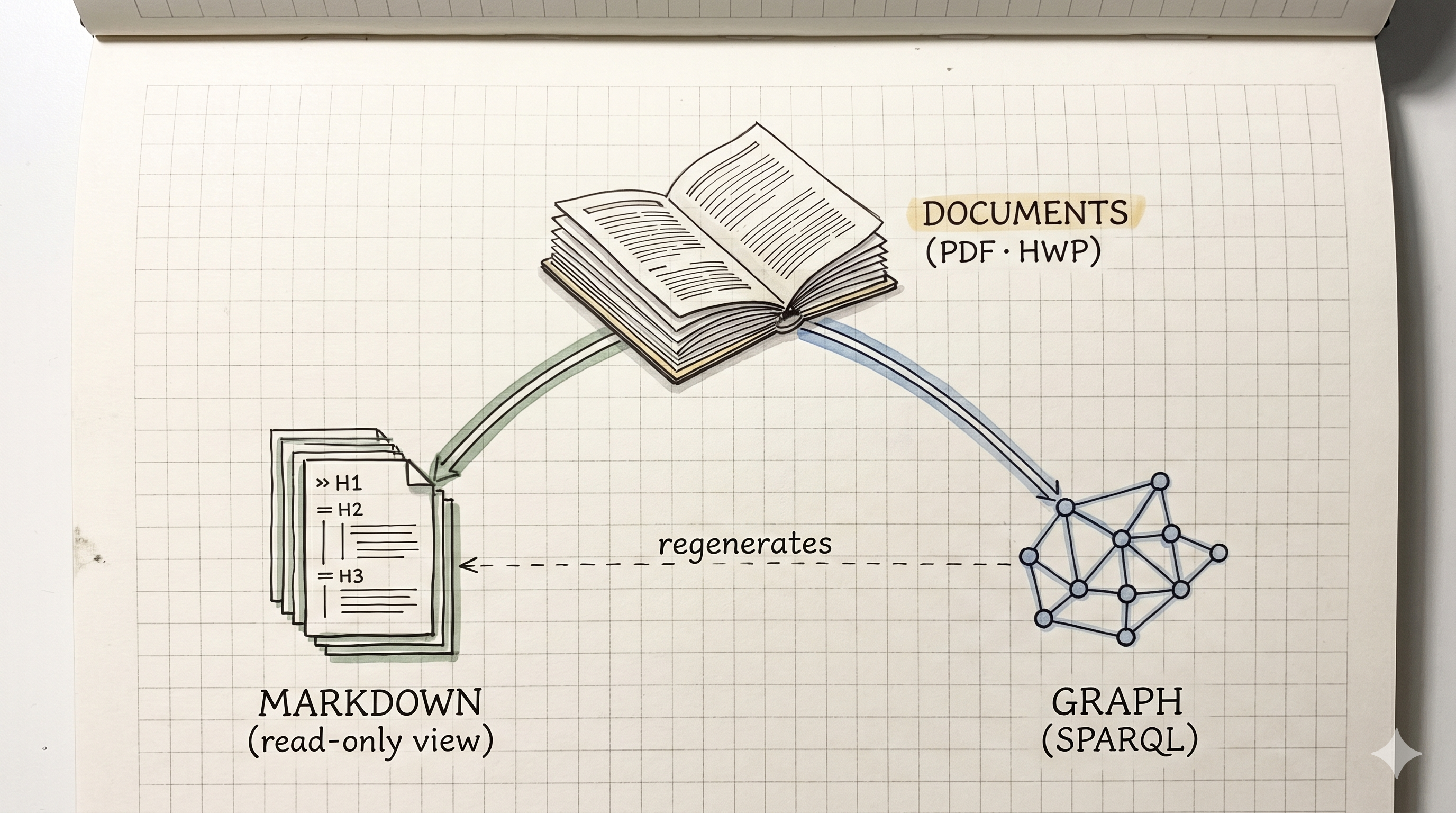
Two days ago I built a markdown knowledge base in an afternoon and called it good. Folders, slugs, frontmatter, a small skill that knew where things went. The bootstrap worked exactly as I hoped - by the end of the day there was enough content for cross-references to start feeling useful.
The trouble is that the day after the bootstrap, I started asking the KB real questions. Show me every project that received funding through a specific agency. Who traveled with me to that country, and which projects were they on at the time? What is our institute’s total contribution across the active projects? Each of these is one or two lines of SQL against a relational store, and I had built a pile of markdown files instead. So I spent today turning the KB into something that can answer those questions, and the interesting parts - again - were the decisions, not the typing.
A note before going further. What started as a personal KB has, in the process of solving these problems properly, slid in the direction of a small operating system: an extraction pipeline, a graph store, an MCP server, a GitHub issue queue, a schema-evolution loop. The texture of the work has changed even if the surface still looks like “I am keeping some notes.” I think that is honest about what useful knowledge bases actually become when you take their questions seriously.
Why bother
The argument for keeping a personal KB in markdown is that markdown is honest: a human writes it, a human reads it, and a single text editor closes the loop. The argument for promoting it to a knowledge graph is that the moment you want structured answers - counts, joins, ranges, aggregations - markdown is the wrong shape. You end up either greping with regular expressions, or you write a small parser that pulls structured fields out of frontmatter, at which point you have built a brittle ad-hoc query layer. A graph just is that query layer, with a real query language.
So the goal for the day was to keep the markdown - it remains the thing I read in Obsidian - but to add a second representation underneath: an RDF graph in Apache Jena Fuseki, that the same content can be reduced to, queryable by both me and any assistant I point at it via an MCP server.
The four architectural calls
1. Markdown as truth, or ontology as truth?
The first instinct is to keep markdown as the source of truth and treat the graph as a derived view. It is the path of least resistance: I already have the markdown, I already have a frontmatter convention, and a small script can flatten that into RDF triples.
The instinct is wrong. The problem is not the conversion script; the problem is that markdown frontmatter is whatever the writer felt like at the time. On day one I had three projects whose role field was the empty string and three more where it was the Korean word for “lead.” The script tried to honor both, and ended up generating triples that said the same institute was both a lead and a member of the same project - a contradiction the graph happily accepted because the script gave it no reason not to. Every cleanup since then has been a variant of the same shape: the markdown was too loose to be a source of truth, and the graph inherited every ambiguity.
The correct answer, the one I am committing to over the next week, is to flip it. The ontology is the truth for the queryable layer. The document the ontology was extracted from - the PDF, the HWP, the spreadsheet - is the upstream truth, the canonical artifact. The markdown is a generated, read-only view for human eyes. If a fact needs to change, it changes in the document or in the graph directly; the markdown is downstream of both.
This sounds severe, but it dissolves a class of bugs the moment it lands. You cannot have two normalizations of the same institute name in the graph because the graph is built by code that runs clean_org_name() exactly once. You cannot accidentally assert that the wrong agency funded a project because the field never existed as plain text for someone to type inconsistently into.
2. What does “the characteristics of a document” even mean - and where do you represent them?
This is where the two layers actually diverge in their expressive power, and it is worth being precise about. Both markdown frontmatter and an OWL ontology can hold “the characteristics of a project.” But they hold them differently.
Markdown frontmatter is flat key-value. A project page has a keti_pi field that holds one name. A consortium field that holds a list. A budget field that holds a number. This works fine until the relationship you want to record has its own attributes. A consortium membership is not just “organization X is in the consortium”; it is “organization X is in the consortium with role Y, and their principal investigator is person Z, and their share of the budget is amount W.” Flatten that into frontmatter and you end up with consortium: [{name, role, pi, share}, …] - already a step toward structured data, but a step that the YAML parser will not enforce and that the next person to edit the file will quietly diverge from.
An ontology models the same fact as a small graph: a Project node, a ConsortiumMembership node attached to it via hasConsortiumMembership, and the Membership node carrying memberOrg, memberRole, memberPI, and memberBudgetShare as its own properties. This is reification - turning a relationship into a thing - and it is what an ontology gives you that flat key-value does not. You pay for it with verbosity, but you get back the ability to ask “which institutes appear as consortium PIs across all projects funded by agency X” without having to invent the join logic yourself.
The principle I now hold: any fact whose relationship has its own attributes belongs in the ontology. Facts that are pure attributes of a single entity - a name, a date, a single number - can live happily in either, and frontmatter is fine for those.
3. How do you actually pull the graph out of a document?
The honest answer is: with a language model, plus a schema. The schema does the heavy lifting. A modern LLM, handed a JSON schema and a document, will fill the schema with surprisingly good fidelity - if the schema is expressive enough to catch the right things and tight enough to refuse the wrong things. Most of my time today went into the schema, not the prompt.
The pipeline I ended up with looks like this:
flowchart TD
    A["Source document<br/>(PDF · HWP)"] --> B["Text extraction<br/>(pypdf / OCR fallback)"]
    B --> C["LLM extraction<br/>+ JSON schema"]
    C --> D["Deterministic post-rules<br/>(name normalization,<br/>unit sanity)"]
    D --> E["Validation<br/>(required fields,<br/>consortium totals)"]
    E -- pass --> F[("RDF triples<br/>→ Apache Jena Fuseki")]
    E -- fail --> G["Review queue<br/>+ GitHub issue auto-opened"]
    F --> H["Markdown view<br/>(read-only, regenerated)"]
Drag to pan · scroll to zoom
The two boxes on the right of the LLM are the load-bearing ones. The LLM will make plausible-sounding mistakes - the post-rules and the validator exist exactly to catch them before they reach the graph. The review queue is the escape hatch for the cases neither layer catches; those become small GitHub issues filed against the project, and they are the only thing that asks for my attention.
4. Local model, or hosted model?
I tried both. My constraints were unambiguous: I am on the flat-rate Pro tier of Claude, and Anthropic’s API is metered separately on top of that. I am unenthusiastic about running up a metered bill on a personal project. That ruled out the Anthropic API as the default extractor, even though it is the most accurate option I have access to. I left it open as something I might use sparingly for the documents that really matter.
The default, then, had to be local. I have a machine with enough RAM to run 32-billion-parameter models comfortably, and Ollama already installed for serving them. The question collapsed to which local model.
There is a real cost to running locally that the literature understates. Local models, even good ones, are more variable than hosted frontier models. They take longer per call. They occasionally refuse to follow the schema in ways that hosted models will not. The fact that they cost nothing per call is the only reason any of this is tolerable - and it is, comfortably, a sufficient reason for the everyday case.
5. Who maintains the ontology?
This is the question I had not really thought about until I had been editing the schema for the third time in a day. The ontology lives in a .ttl file. The LLM extractor needs to know about every property the ontology defines, or it cannot extract them. The natural-language-to-SPARQL helper that sits behind the MCP server also needs to know about every property, or it will hallucinate names that do not exist. So every time I added a single property, I was editing three places: the ontology file, the JSON schema the extractor uses, and the prose guide the query helper reads.
After the third round I wrote a small generator. The .ttl file is now the only place I edit; the JSON schema and the prose guide are both regenerated from it. The query helper re-reads the prose guide on every call, so I do not have to restart the MCP server to roll out a vocabulary change. The next step is to do the same for the extractor schema. After that, the ontology really is the single artifact - everything else is derived.
The deeper point: an ontology that is hand-synchronized across three representations is an ontology that drifts. The only sustainable model is one canonical representation and a build step that produces the rest.
Model comparison
I needed to put numbers on the “local model is acceptable” claim, so I ran a controlled comparison. One long Korean-language technical document, about twenty-three thousand characters of body text, with structured metadata to extract: project identifiers, dates, budget figures, a multi-organization consortium, role assignments. I ran the same input through three different extractors and scored the output field-by-field.
The three extractors were:
- Claude (in-session). The Anthropic model I use day to day, with the document handed to it directly inside a conversation rather than through the API. No metering - the cost is amortized into the Pro subscription. The downside is that it is interactive, not a pipeline component.
-
qwen2.5:32b(local, served by Ollama). A 32-billion-parameter Alibaba-developed model that handles Korean well and respects strict JSON output. Quantized Q4_K_M, served by a local daemon. -
exaone3.5:32b(local, served by Ollama). A 32-billion-parameter Korean-developed model from LG AI Research, optimized for Korean. Same quantization, same server.
I scored fifteen scalar fields (identifiers, dates, names, budgets, roles) plus the structured arrays (consortium membership, annual budgets). The table below summarizes the result.
| Dimension | Claude (in-session) | qwen2.5:32b | exaone3.5:32b |
|---|---|---|---|
| Scalar fields matching ground truth (of 15) | 15 | 9 | 8 |
| Wrong-value fields | 0 | 1 (institutional slot) | 3 (budget unit, lead org, program name) |
| Followed schema instructions strictly | yes | mostly | only after a flag change |
Native format=json mode in Ollama | n/a | works | returns {} (empty) - needed a free-text fallback |
| Wall-clock time per document | conversational | 4m 39s | 3m 30s |
| Per-document cost | included in Pro subscription | zero | zero |
| Pipeline-friendly (batch, repeatable) | no | yes | yes |
A few things stood out.
Claude is better, but it is better in the way that having a careful colleague read your document is better. It is not what you want to hand a queue of fifty PDFs to.
qwen2.5:32b is genuinely useful as a batch extractor. The headline failure is a subtle one: in a multi-institution consortium, it kept inserting my own institute as one of the partner organizations rather than recognizing it as the actor whose perspective the document is written from. That is a deterministic post-fix - strip the alias, promote the corresponding lead to a different field - and once you have written that thirty lines of code, the model becomes serviceable. Almost everything else it gets right.
exaone3.5:32b was the surprise. On paper it should be the Korean specialist. In practice, with Ollama’s strict format=json mode, it returned an empty object - every field null. I have since narrowed the problem down to that one flag: removing the strict-JSON instruction and reading the schema only from the system prompt makes it produce reasonable output. But even then it had a more substantial failure mode than qwen - in two places it dropped the leading institute from the consortium entirely, and in one place it misread the currency unit by a factor of a thousand. The leading-institute drop is symmetric to qwen’s problem, which is mildly interesting; the unit error is the worse failure, because nothing downstream catches it without a sanity check on magnitudes.
The honest summary: for an unattended pipeline, the small local model that handles strict JSON cleanly and only makes one predictable mistake is the right default. Reserve the better, more expensive option for cases where correctness on the first try genuinely matters.
The schema evolution loop
The most interesting open question is what happens when the KB is asked about a concept the ontology does not yet model. Say I ask the query helper, show me every project that has a commercialization plan. The ontology has no commercializationPlan property. The SPARQL the helper generates returns nothing. I look at the result, conclude the KB is incomplete, and either let it go or - better - extend the ontology, add the property, and rerun the extractor against the documents I already have.
This second path is the schema evolution loop, and it is the thing that turns a static graph into a living one:
flowchart TD
    Q["User asks a question<br/>about a concept the<br/>ontology does not model"] --> R["Query returns empty,<br/>or LLM cannot map<br/>to existing predicates"]
    R --> L["Log the gap<br/>(keyword + frequency)"]
    L --> P["Propose ontology<br/>extension<br/>(human-reviewed)"]
    P --> O["Edit .ttl"]
    O --> S["Regenerate JSON schema<br/>+ prose guide"]
    S --> E["Re-extract only<br/>the new fields<br/>from cached documents"]
    E --> G[("Updated graph")]
    G -.next time the question is asked.-> Q
Three things make this hard. First, detecting that a question hits a gap rather than just a sparse part of the existing schema; the heuristic is to look at the SPARQL the helper produced and check whether it used any predicate that does not exist in the ontology, or whether the result set is empty for a question whose keywords do not match any existing predicate’s label. Second, proposing the extension responsibly; an LLM can suggest a reasonable class or property given the keyword, but the human still has to confirm because ontologies that grow without curation become incoherent. Third, re-extracting only what is new; running the full extraction over every document for every schema change would be prohibitive, so the cache has to be keyed by (document, field) rather than document alone.
None of this is novel as an idea. What is rare is taking it seriously enough to wire it into the everyday loop. The bet I am making is that if the extension cost stays cheap, my actual usage of the KB will be the thing that grows the ontology - driven by real questions rather than by my imagined ones.
Terminate-on-failure as an operating model
One thing I decided early and want to record: the pipeline terminates on certain validation failures rather than papering over them. When the extractor returns a budget that is two orders of magnitude smaller than the running average, the pipeline does not silently store the wrong number. It writes a small JSON file to a review folder, opens a GitHub issue with the slug of the offending document and the specific check that failed, and stops. The graph is left in its last known good state.
This sounds restrictive - and the first day or two it was restrictive, because the validators were stricter than they should have been and I had to relax them. But it dissolves the worst failure mode of LLM-driven pipelines, which is the slow accumulation of plausibly-wrong data that you only notice when an aggregate query gives an answer that is off by just enough to be confusing. Confusing-but-not-obviously-wrong data is worse than no data at all; it makes you distrust the whole system.
The operating model is: the pipeline never guesses; when it cannot decide, it asks. Issues are the asking mechanism. They are also, incidentally, a perfect audit log - every weird case in the data shows up as a closed (or open) issue with a closing comment describing what I decided and why.
For an LLM-driven system, I think this is the right default. Optimizing for throughput tempts you toward silent fallback values. Optimizing for trust pushes you toward loud failure.
Reflections, and where this is going
A few things I did not expect.
The ontology is small, and that is fine. Ten classes, forty-four properties. I will add to it as the schema-evolution loop demands, and the build step means each addition is cheap. The premature instinct to model everything has been the death of more KBs than I care to count.
The Korean dimension matters more than I would have guessed. Three of my hard problems today were Korean-specific: language tags on string literals (the @ko suffix that broke half my early SPARQL queries), normalization of organization names that have a corporate prefix in some places and not others (㈜ vs nothing), and an enum value I had simply forgotten to list (“under proposal”). None of these are deep, but they required the day’s worth of bug-hunting that I had not budgeted for.
The personal-to-operational drift was real. This started as a personal knowledge base and is now closer to a small operating system. I do not think that is bad - it just means I should stop pretending the problem is “keeping notes” and start treating it as building a small internal tool that I happen to be the only user of.
The next steps are clear enough. Finish the schema evolution loop so the query helper actively recognizes gaps. Move the input edge of the pipeline onto a folder watcher so that dropping a new PDF into the right cloud folder is the only thing I have to do. Once I trust the auto-regenerated markdown views, retire the hand-written ones in favor of them.
The thing I am most curious about, again, is whether this changes the texture of what I ask the KB. With markdown, my questions were the shape “find me the file about.” With a graph in Fuseki, the questions can become “count,” “average over,” “show me where two things overlap.” That is a different kind of utility. I will know in a week whether it is one I actually wanted.