What an Industrial Foundation Model Should Be

한국어 버전: 산업 파운데이션 모델은 무엇이어야 하는가
AI is being pushed into one field after another, and faster every year. In Korea that push has a particular shape: a wave of public R&D money aimed at industrial foundation models. Across the programs announced lately, the ministries — MOTIE, MSIT, and others — keep pairing two themes: the importance of data, and the need to share that data in order to build industrial foundation AI.
It’s worth pausing on what we’re actually asking for. What is a foundation model, exactly? And what would an industrial foundation model have to do to deserve the name?
What makes a model “foundational”
There are many definitions, but the report that first pinned the term down — Stanford’s CRFM — describes a foundation model as one “trained on broad data … that can be adapted to a wide range of downstream tasks.”1 The center of gravity sits on adaptable, not all-knowing: the whole point is that you can build something on top of it.
Take the word at face value. A foundation model should be something that grounds other things — less a God-Almighty that understands everything and solves every problem, and more the bedrock, or the cornerstone, you set the rest of the building on.
An omniscient model is not a foundation
That distinction isn’t academic; it shapes how such a model lands in an industry. Picture a foundation model for the semiconductor business. Suppose some chipmaker, sitting on an enormous trove of data, trains an excellent model that guides decisions across its fabrication process. Now suppose it ships that model under the banner of a foundation model. What happens to the barriers to entry in that market? They come down.
The first mover would simply be handing its hard-won know-how to everyone behind it — a pure floor-lifting effect that raises the floor for latecomers at the leader’s own expense. A model like that is more accurately called almighty or omniscient than foundational. It’s closer to a finished product than to a base you build on.
A foundation holds knowledge up; it doesn’t hold it in
So when I say foundation model, I don’t mean a model that already contains every domain’s knowledge. I mean one whose job is to let that knowledge be stacked on top of it. Domain expertise accumulates on the industrial foundation model and spreads outward — into manufacturing, into service operations, into quality management, into one domain-specific model after another. Only then does the word foundation actually fit.
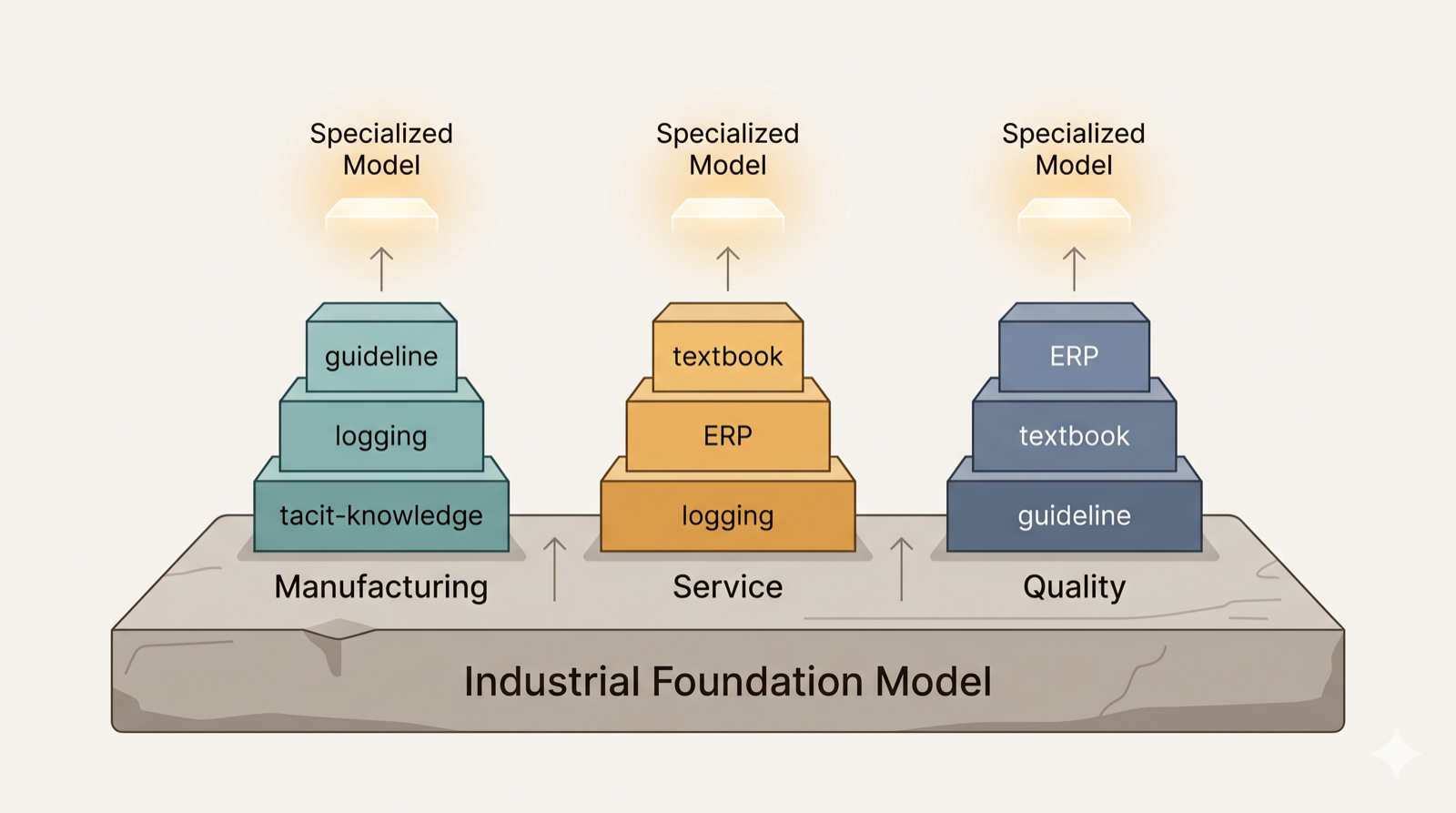
Domain knowledge stacks on top of the industrial foundation model at the base, growing into a specialized model for each domain.
So what actually matters
Which means the thing to get right, when we talk about industrial foundation models, is a base-shaped service: one that can read each domain’s language and support its connection to domain knowledge. Not a model with every answer pre-loaded, but one on top of which each domain’s answers can grow.
Europe’s IPCEI-AI initiative — the AI strand of the Important Projects of Common European Interest — is a fairly concrete picture of this view.2 It frames the development of industrial AI models not as a single finished artifact but as a three-layer life-cycle.
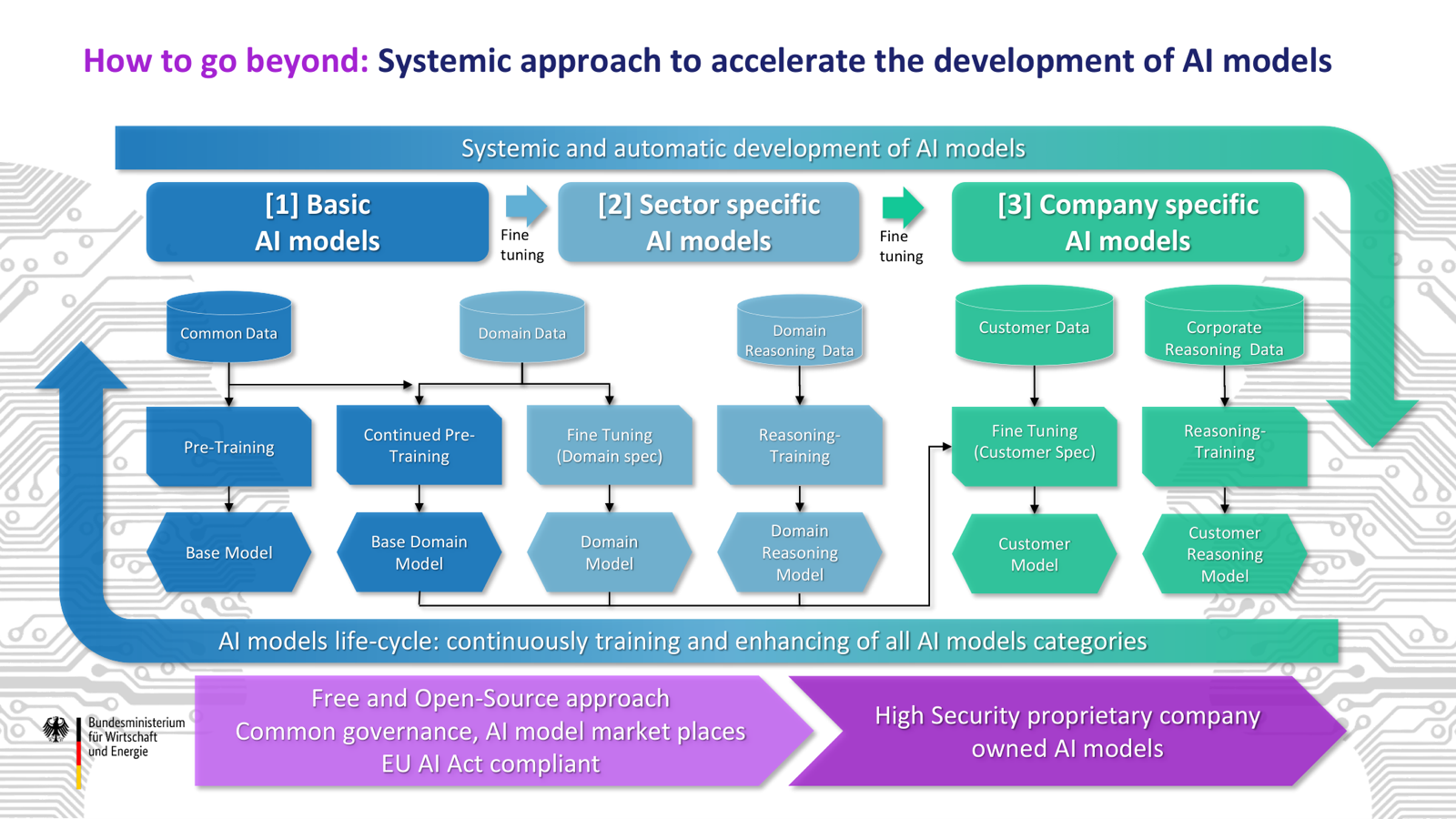
IPCEI-AI's three-tier life-cycle for industrial AI development. The base model stays open and shared (free and open-source); each layer above narrows toward domain- and company-specific models. Source: BMWE, IPCEI-AI.
- Basic AI models. The base model at the bottom, pre-trained on common data. The decisive move is to define this layer as a kind of public good — free and open-source, with common governance, AI-model marketplaces, and EU AI Act compliance.
- Sector-specific AI models. On top of that, fine-tuning and continued pre-training on domain data produce domain models, and then domain reasoning models.
- Company-specific AI models. Higher still, fine-tuning on customer and corporate data yields high-security, company-owned proprietary models.
What I find compelling is that this picture answers the floor-lifting dilemma through its structure. The base layer is open for anyone to stand on, while a company’s real know-how stays in the domain- and company-specific layers above. Put another way, it draws the line for how much to open up as foundation below the know-how. The base lifts everyone’s floor as a public good, and yet the first mover never has to hand over its own cornerstone wholesale.
The other thing worth noticing is that the three layers aren’t a static deliverable you build once. They’re bound together as a continuously trained, continuously improving life-cycle. Fine-tuning and continued pre-training are the connective tissue between the layers, and keeping that flow unbroken is precisely the foundation’s job. In the end, the value of an industrial foundation model comes not from how much it knows, but from how well domain and company knowledge can grow on top of it.
-
Bommasani et al., “On the Opportunities and Risks of Foundation Models,” Stanford CRFM, 2021. arXiv:2108.07258 ↩
-
IPCEI-AI (Important Projects of Common European Interest – Artificial Intelligence), coordinated by the German Federal Ministry for Economic Affairs and Energy (BMWE). IPCEI Artificial Intelligence (BMWE) ↩